Extended Imaging, Velocity Analysis, and the Road to FWI
Schools of EAS, CSE, ECE — Georgia Institute of Technology
2026-04-01

Felix J. Herrmann
School of Earth and Ocean Sciences — Georgia Institute of Technology
Based on Hou and Symes (2015), Hou and Symes (2016), and Hou and Symes (2018).

Noah Harding Professor Emeritus
Computational & Applied Mathematics, Rice University
Subsurface-offset common-image gathers (CIGs) serve two purposes:
This lecture
We focus on velocity model building — using the extended image volume to update the background velocity \(v_0\). The directional/AVA aspect will be covered later.
From our RTM and LSM lectures, we know:
Key question
What if \(v_0\) is wrong? Can we still extract useful information from the image to update the velocity?
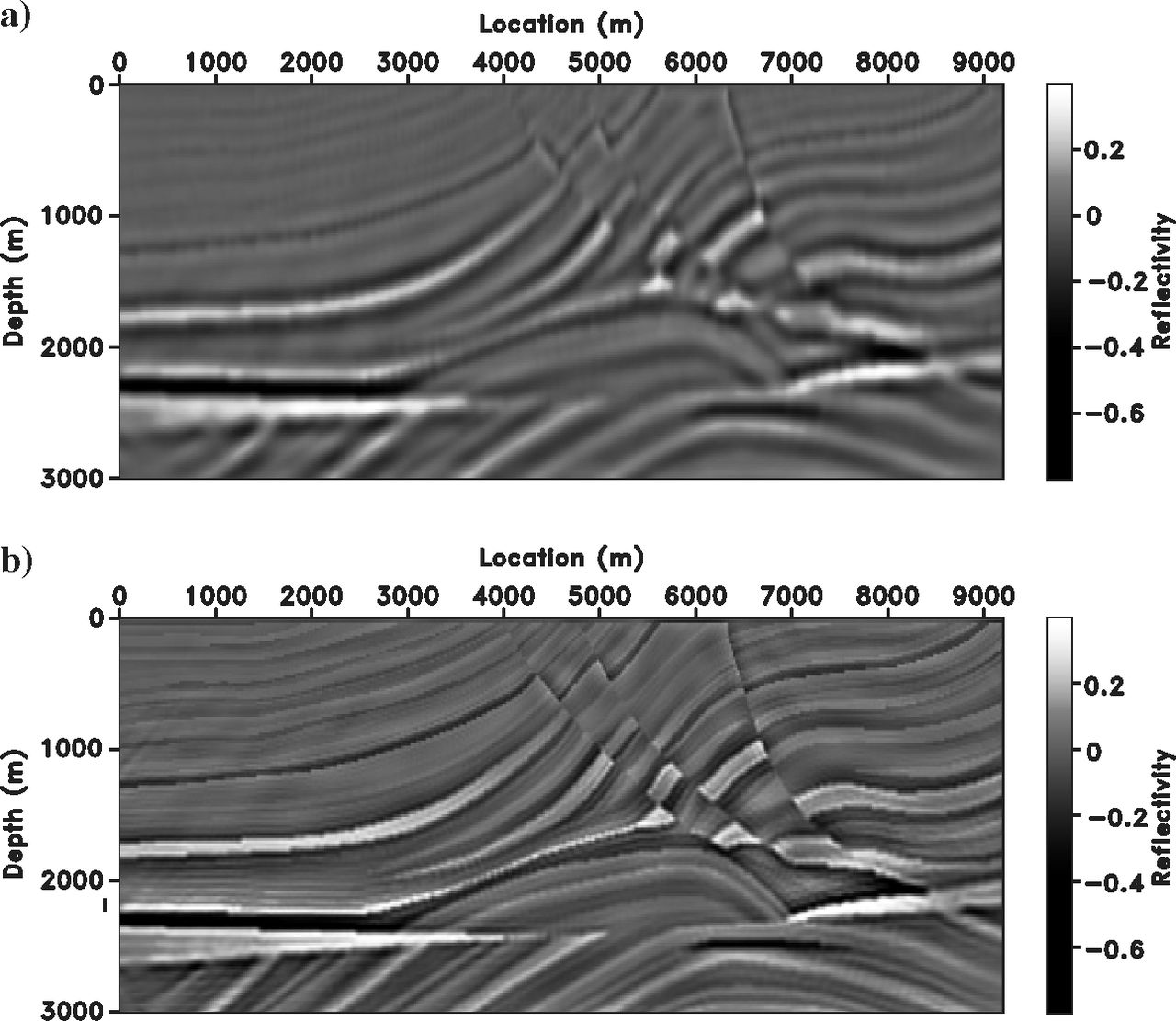
The velocity is decomposed as \(v(\mathbf{x}) = v_0(\mathbf{x}) + \delta v(\mathbf{x})\), where \(v_0\) is smooth and \(\delta v\) contains reflectors (Hou and Symes 2015).
The Born modeling operator \(F[v_0]\) maps reflectivity \(\delta v\) to scattered data:
\[ (F[v_0]\delta v)(\mathbf{x}_s, \mathbf{x}_r, t) = \frac{\partial^2}{\partial t^2} \int d\mathbf{x}\, d\tau\, G(\mathbf{x}_s, \mathbf{x}, \tau) \frac{2\delta v(\mathbf{x})}{v_0(\mathbf{x})^3} G(\mathbf{x}, \mathbf{x}_r, t - \tau) \tag{1}\]
This is Equation 6 of Hou and Symes (2018). Compare with discrete expression
\[ \begin{align}\mathbf{J}&=\nabla\mathcal{F}[\mathbf{x}_0]\\ &=-\mathbf{P}_r\mathbf{A}^{-1}[\mathbf{x}]\mathrm{diag}\big(\frac{\partial\mathbf{A}[\mathbf{x}]}{\partial\mathbf{x}}\mathbf{A}^{-1}[\mathbf{x}]\mathbf{P}^\top_s\mathbf{q}\big)\Bigr|_{\mathbf{x}_0} \end{align} \]
In the discrete notation of our RTM lecture:
| Continuous (Papers) | Discrete (Lecture A) |
|---|---|
| \(F[v_0]\,\delta v = \delta d\) | \(\mathbf{F}\,\delta\mathbf{m} = \delta\mathbf{d}\) |
| \(G(\mathbf{x}_s, \mathbf{x}, t)\) | \(\mathbf{A}^{-1}(\mathbf{m})\,\mathbf{q}_s\) |
| \(F^*[v_0]\,\delta d\) (RTM) | \(\mathbf{F}^T\,\delta\mathbf{d}\) (adjoint) |
| Imaging condition | \([\nabla_\mathbf{m} J]_i = \sum_s \sum_k v_s(x_i,t_k)\,\ddot{u}_s(x_i,t_k)\,\Delta t\) |
Note
The Born modeling operator \(F[v_0]\) in the papers corresponds to the stacked Jacobians \(\mathbf{F} = [\mathbf{J}_1^T, \ldots, \mathbf{J}_{n_s}^T]^T\) from our LSM lecture $.
The Born inverse problem seeks \(v_0\) and \(\delta v\) such that \(F[v_0]\,\delta v \approx d\) (Hou and Symes 2018).
The way out
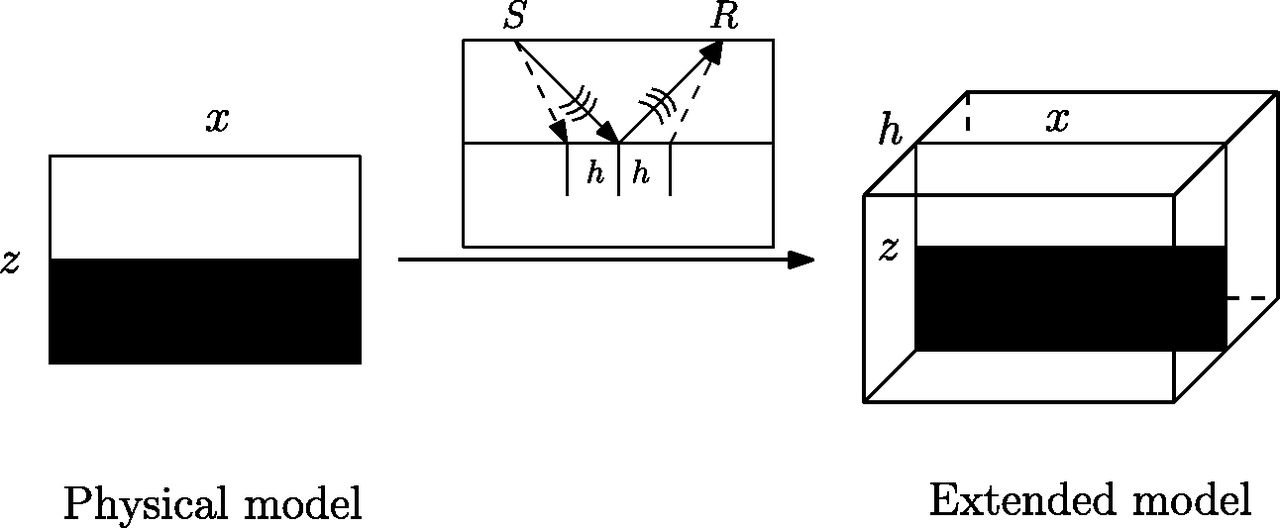
If \(\delta v\) is extended to depend on an extra dimension (subsurface offset \(h\)), i.e., replaced by \(\delta\bar{v}(\mathbf{x}, h)\), then any model-consistent data can be fit with essentially any \(v_0\) by proper choice of \(\delta\bar{v}\).
Sketch of the subsurface offset extension. The subsurface offset \(h\) is half the distance between subsurface scattering points. This extension allows stress to produce strain at a distance (Hou and Symes 2016).
The reflectivity \(\delta v(\mathbf{x})\) is replaced by \(\delta\bar{v}(\mathbf{x}, h)\), and the extended Born modeling operator \(\bar{F}[v_0]\) is defined as (Hou and Symes 2018, Eq. 7):
\[ (\bar{F}[v_0]\delta\bar{v})(\mathbf{x}_s, \mathbf{x}_r, t) = \frac{\partial^2}{\partial t^2} \int d\mathbf{x}\, dh\, d\tau\, G(\mathbf{x}_s, \mathbf{x} - h, \tau) \frac{2\delta\bar{v}(\mathbf{x}, h)}{v_0(\mathbf{x})^3} G(\mathbf{x} + h, \mathbf{x}_r, t - \tau) \tag{2}\]
Here \(h\) is half the distance between sunken source and sunken receiver in Claerbout’s survey-sinking imaging condition (Claerbout 1985).
Physical meaning: We now allow reflection at a distance — a nonphysical extension that matches the model dimension with the data dimension.
The extended imaging operator is the adjoint of \(\bar{F}\) — i.e., extended RTM (Hou and Symes 2018, Eq. 8):
\[ I(\mathbf{x}, h) = (\bar{F}^*[v_0]\,d)(\mathbf{x}, h) = \frac{2}{v_0(\mathbf{x})^3} \int d\mathbf{x}_s\, d\mathbf{x}_r\, dt\, d\tau\, G(\mathbf{x}_s, \mathbf{x} - h, \tau)\, G(\mathbf{x} + h, \mathbf{x}_r, t - \tau) \frac{\partial^2}{\partial t^2} d(\mathbf{x}_s, \mathbf{x}_r, t) \tag{3}\]
In our lecture notation, the extended RTM corresponds to:
\[\boldsymbol{\delta}\bar{\mathbf{v}}[\mathbf{x}, h_x]=\bar{\mathbf{F}}^T\,\delta\mathbf{d}=\sum_s\sum_t\mathbf{v}_s[\mathbf{x}+h_x]\ddot{\mathbf{u}}_s[\mathbf{x}-h_x,t]\]
where \(\bar{\mathbf{F}}\) now depends on both spatial position \(\mathbf{x}\) and subsurface offset \(h\). Corresponds to the cross-covariance between the forward and adjoint wavefields.
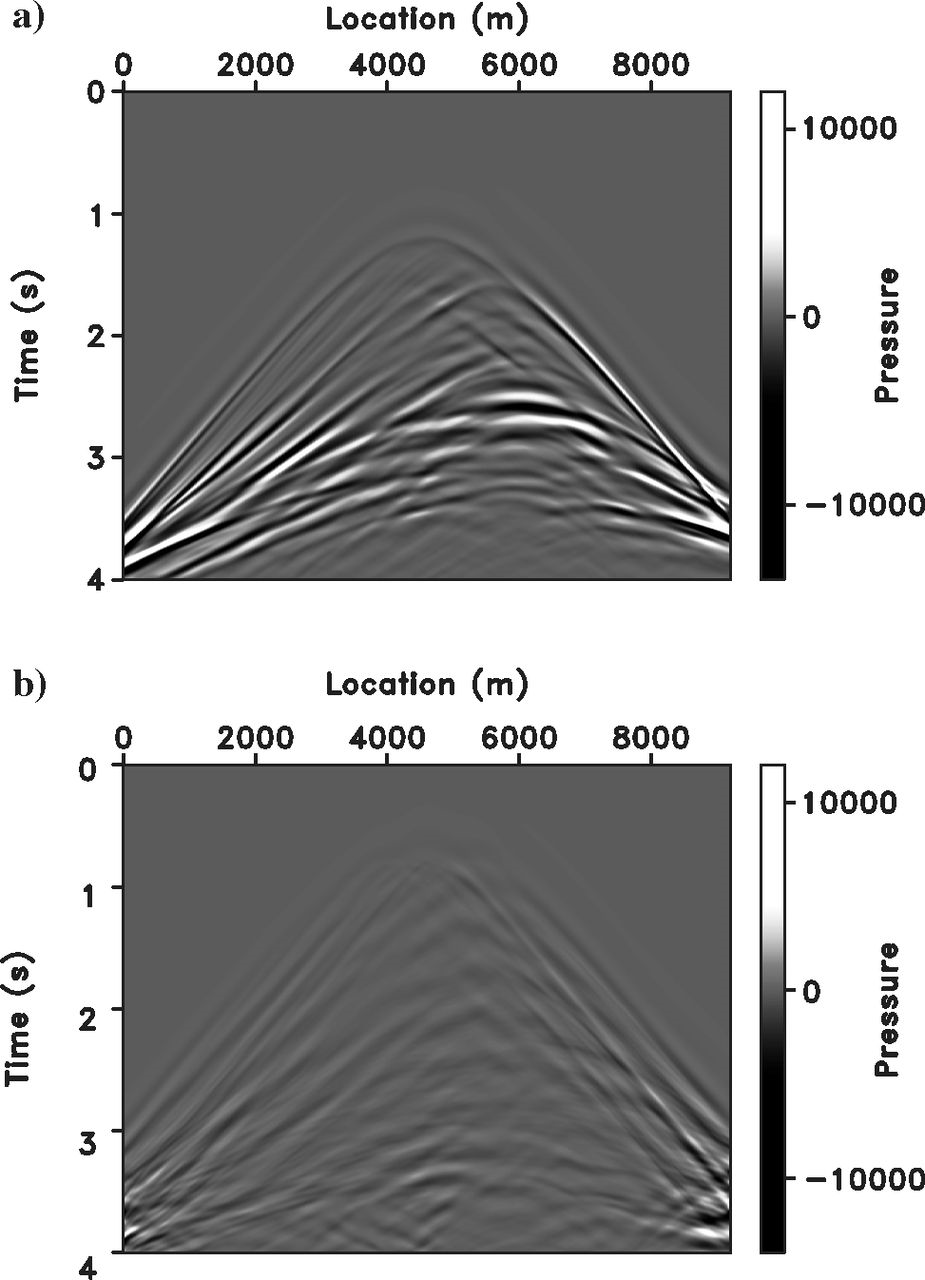
We define the reflection data as the difference between nonlinear data and data simulated in the background-velocity model (Hou and Symes 2018, Eq. 3):
\[ \delta d = \mathcal{F}[v] - \mathcal{F}[v_0] \approx F[v_0]\,\delta v \]
where \(\mathcal{F}[v]\) is the nonlinear forward modeling operator mapping velocity to data.

Tip
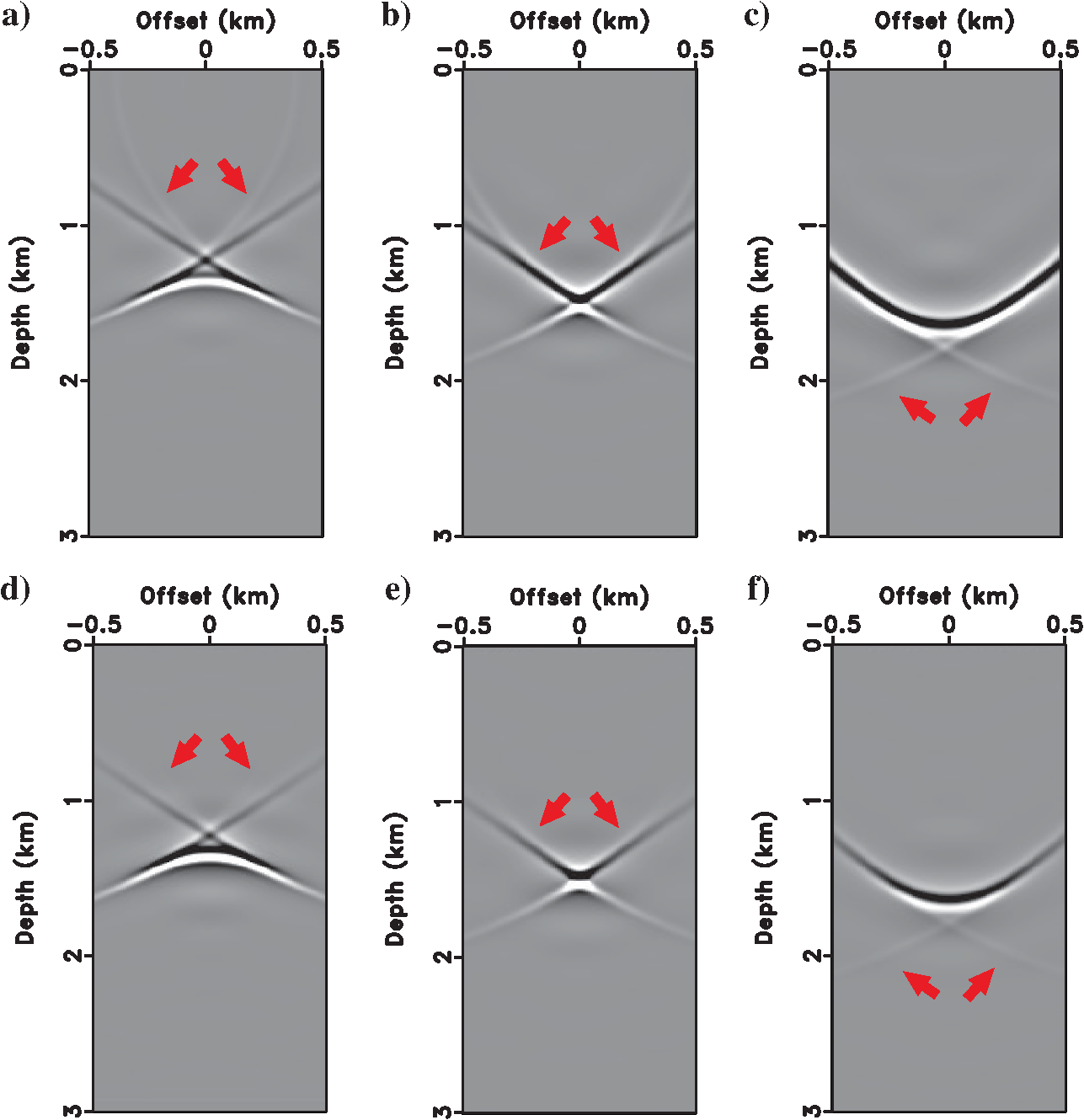
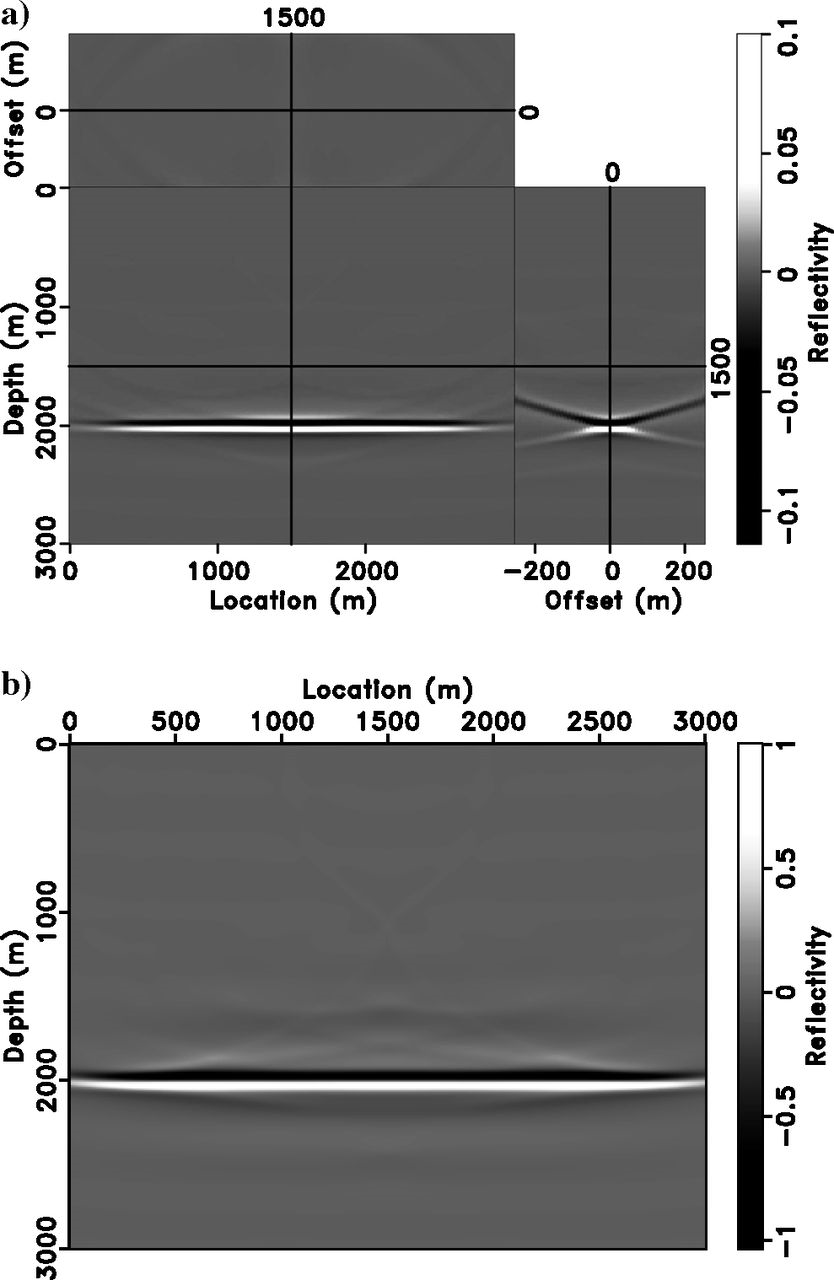
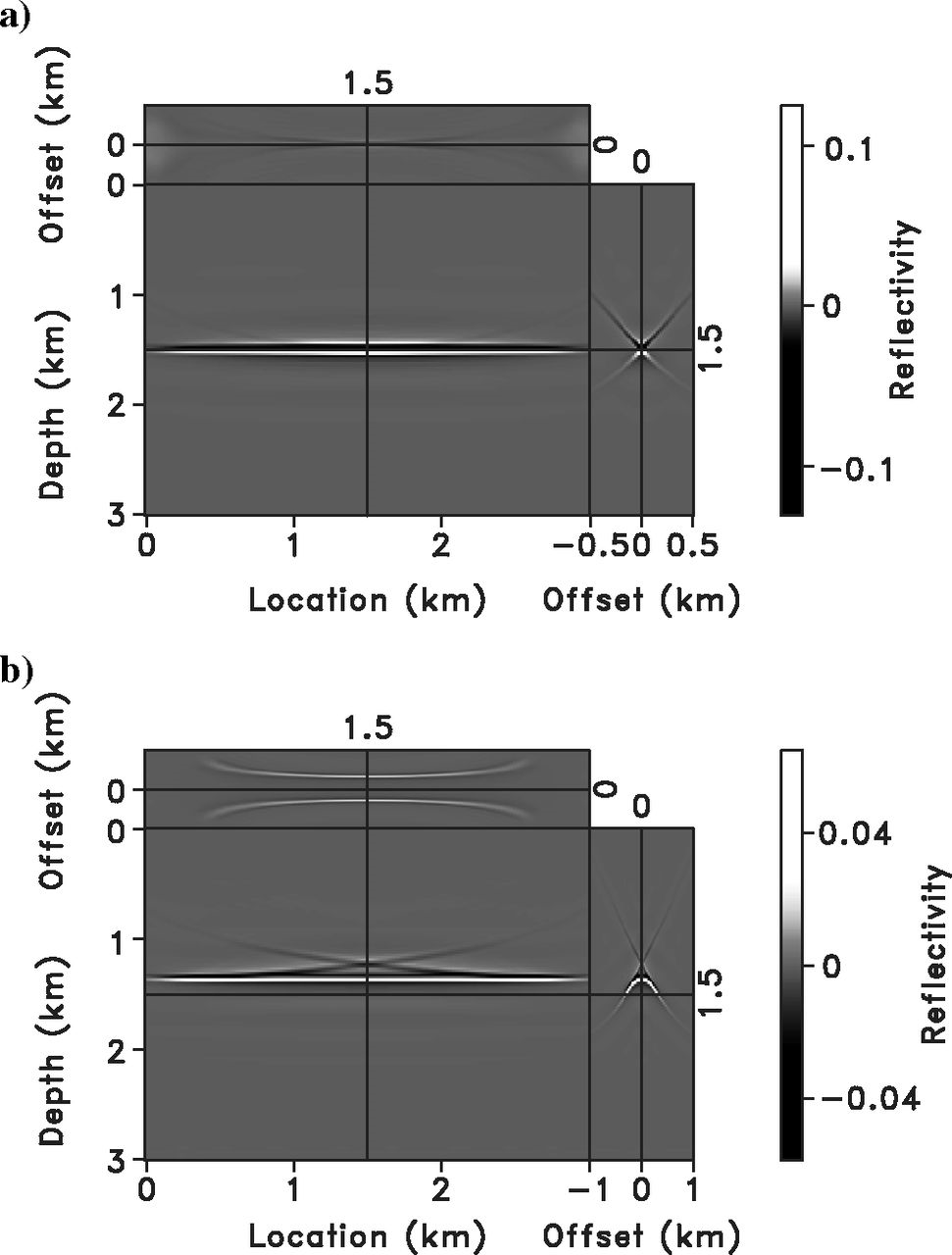
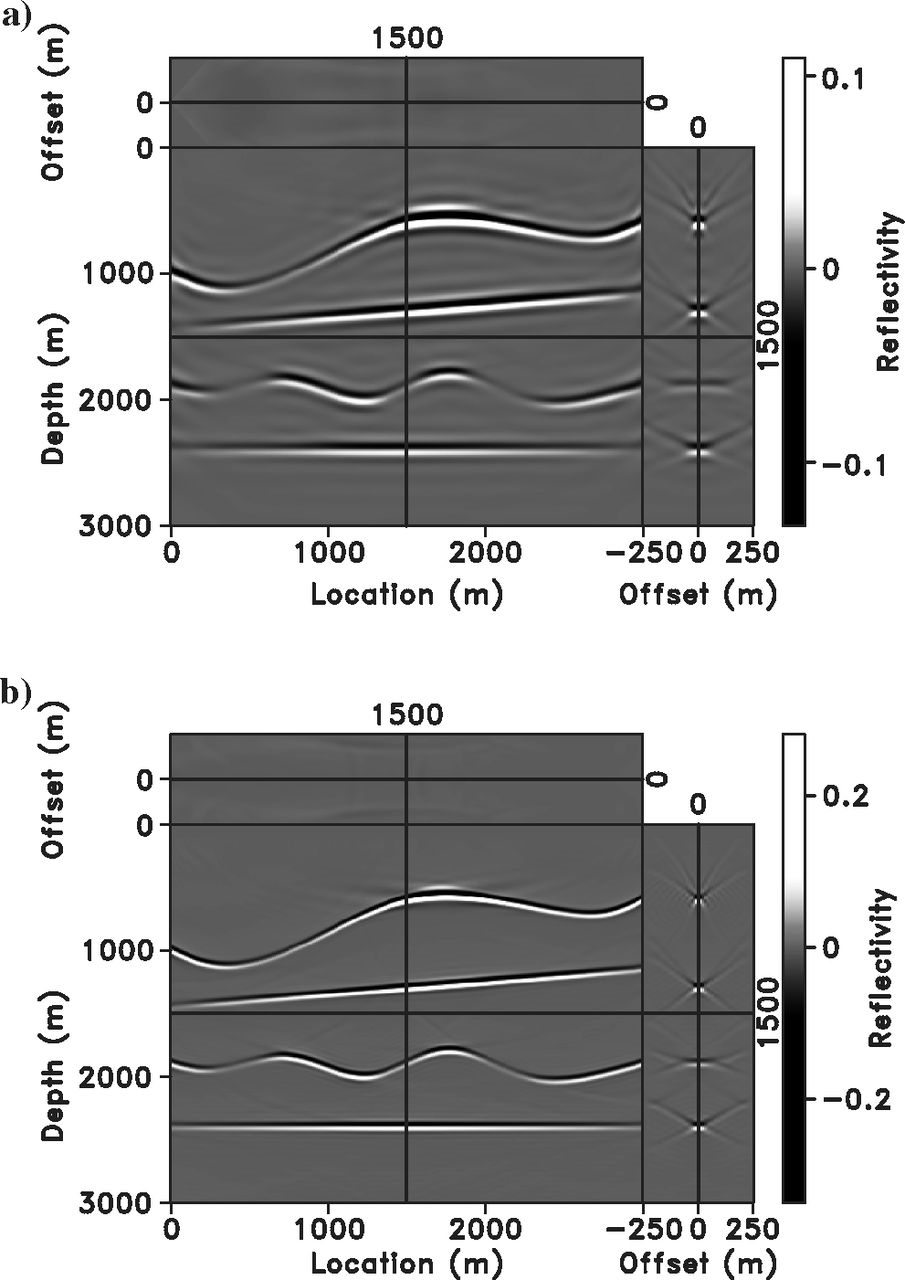
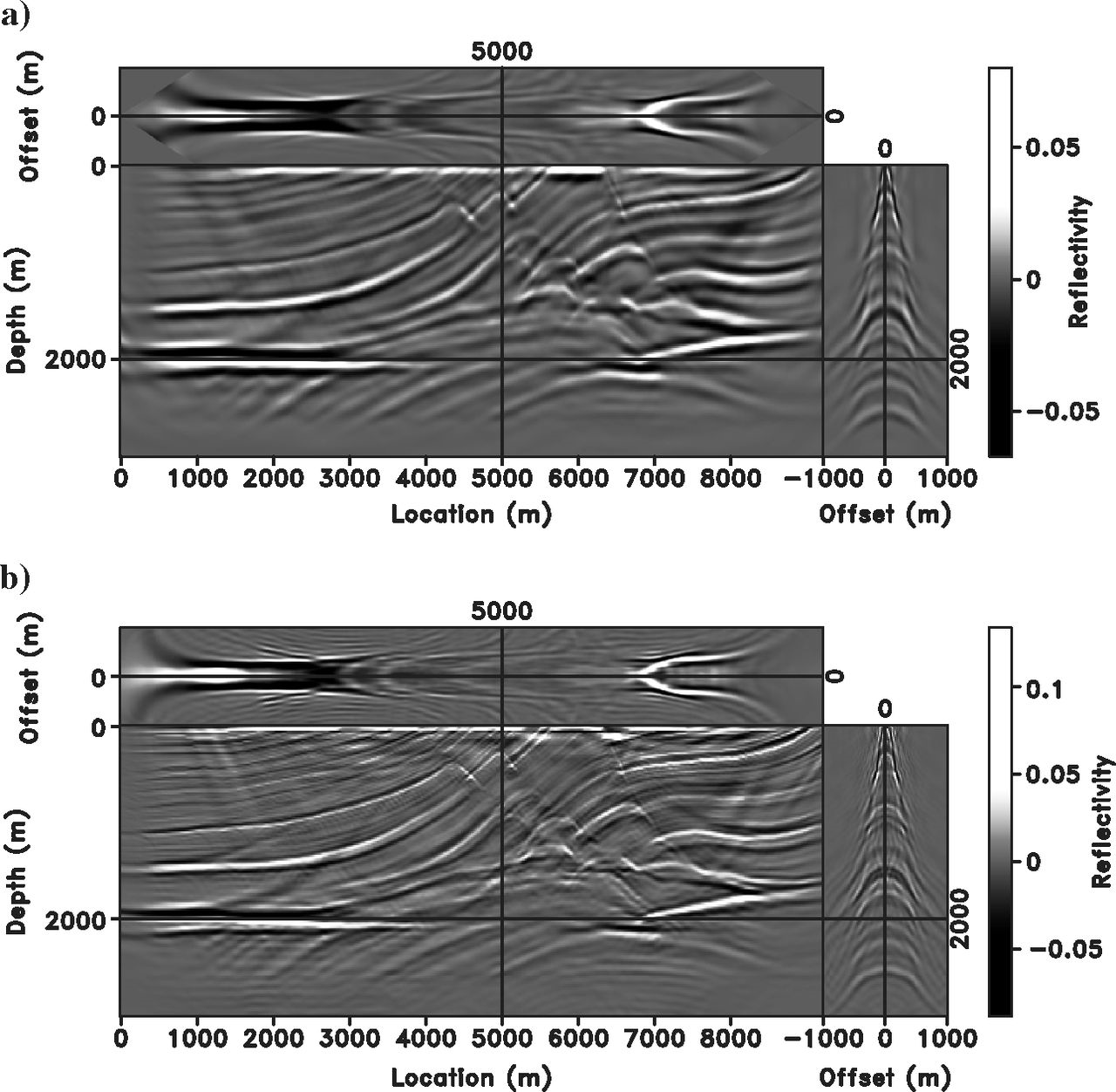
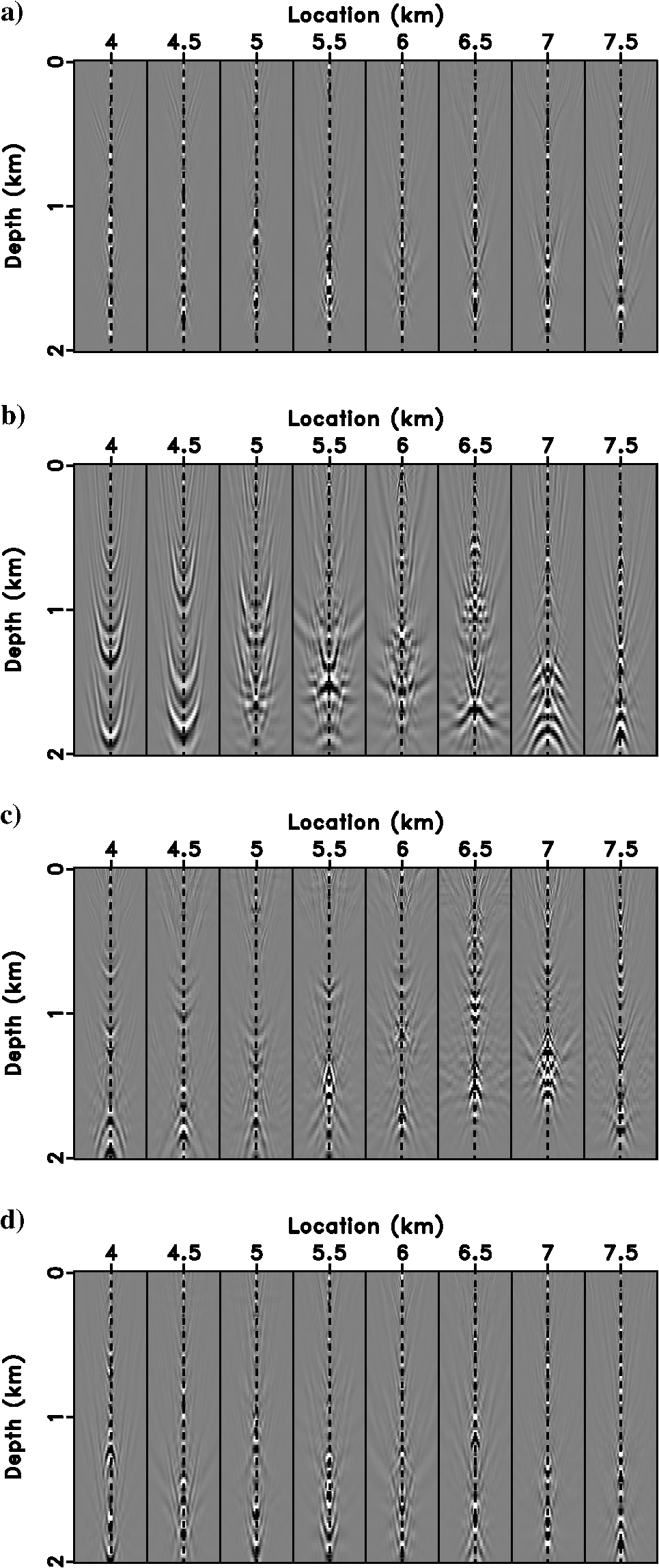
Energy focuses at \(h = 0\) with correct velocity and spreads to nonzero \(h\) when velocity is incorrect.


The approximate inverse to the extended Born modeling operator takes the form (Hou and Symes 2015, Eq. 1):
\[ \bar{F}^\dagger[v_0] = W_{\text{model}}[v_0]\; \bar{F}^*[v_0]\; W_{\text{data}}[v_0] \tag{4}\]
In our LSM lecture notation, this corresponds to left and right preconditioning:
\[ \tilde{\mathbf{m}} = \mathbf{M}_R^{-1}\,\tilde{\mathbf{u}}, \quad \hat{\mathbf{F}} = \mathbf{M}_L^{-1}\,\mathbf{F}\,\mathbf{M}_R^{-1} \]
where:
The weight operators that make \(\bar{F}\) approximately unitary (Hou and Symes 2018, Eq. 10):
\[ W_{\text{model}}^{-1} = -8v^4 D_z Q, \qquad W_{\text{data}} = I_t^3\, D_{z_s}\, D_{z_r} \]
where:
Note
\(W_{\text{data}}\) depends only on \(v_0\) near sources and receivers — independent of the deep velocity structure. The computational cost of \(\bar{F}^\dagger\) is roughly the same as extended RTM. Approximately unitary means that the adjoint is close to the inverse and that most enegry/information is preserved.


From our LSM lecture, the least-squares objective is:
\[ J_{\text{LS}} = \frac{1}{2}\|\mathbf{F}\,\delta\mathbf{m} - \delta\mathbf{d}\|^2 \]
Extended LSM replaces \(F\) by \(\bar{F}\) and \(\delta v\) by \(\delta\bar{v}(\mathbf{x}, h)\) (Hou and Symes 2016):
\[ J_{\text{ELSM}} = \frac{1}{2}\|\bar{F}[v_0]\,\delta\bar{v} - \delta d\|^2 \]


Tip
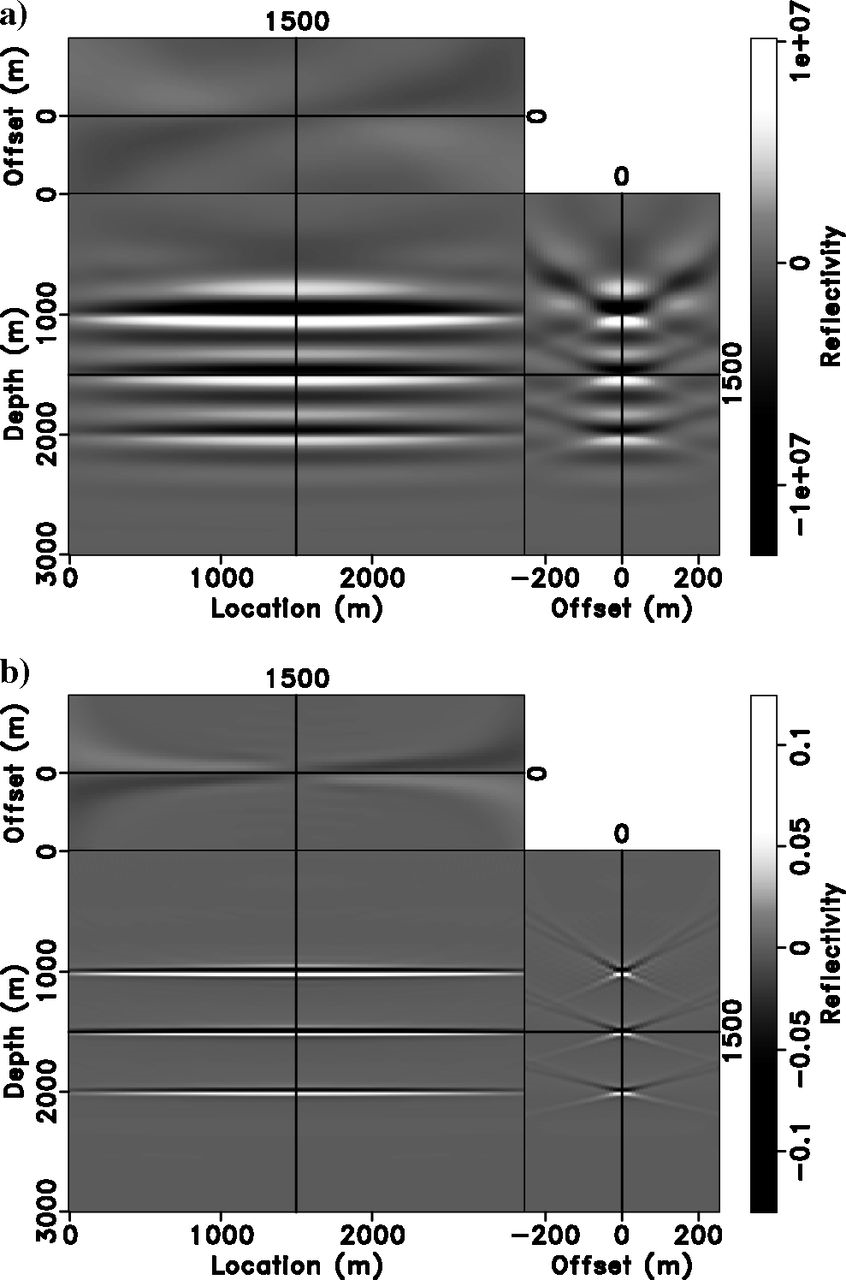
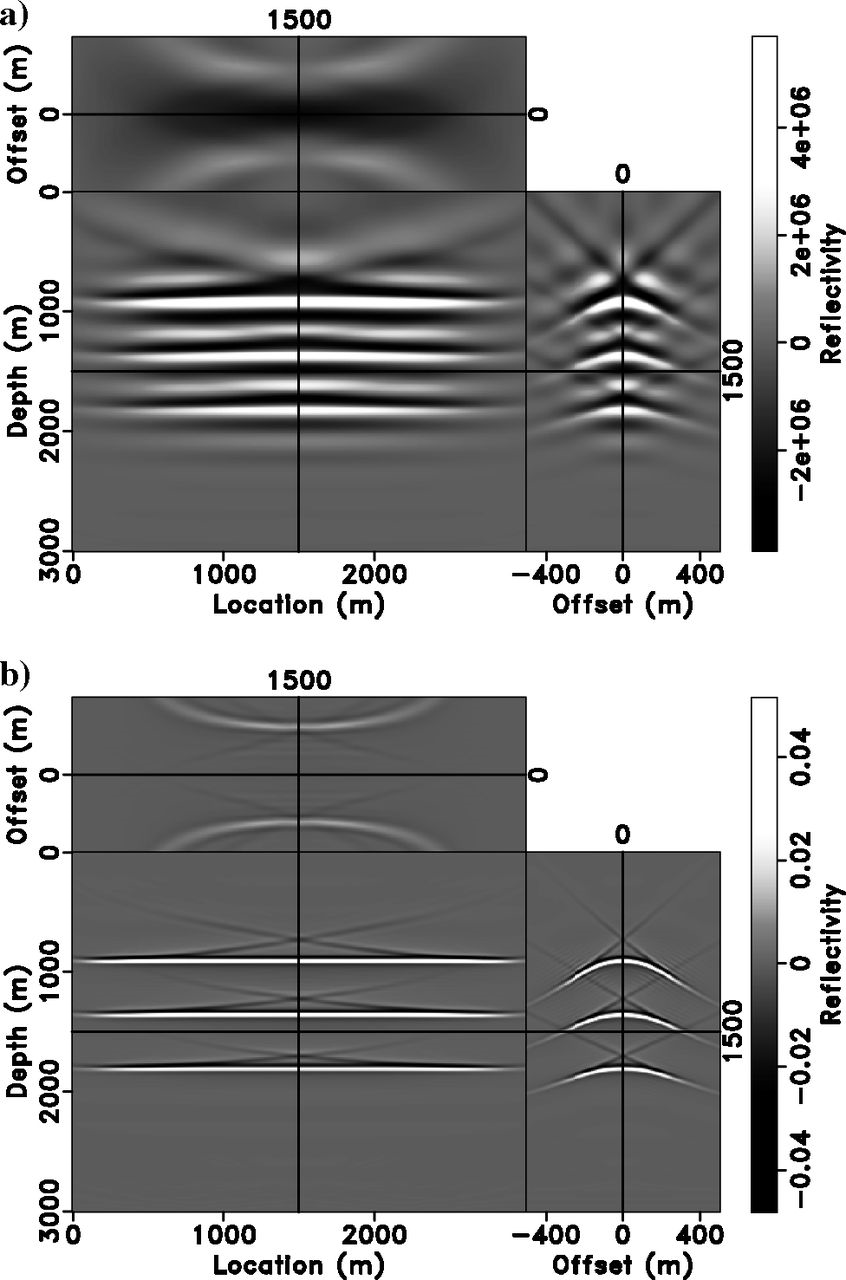
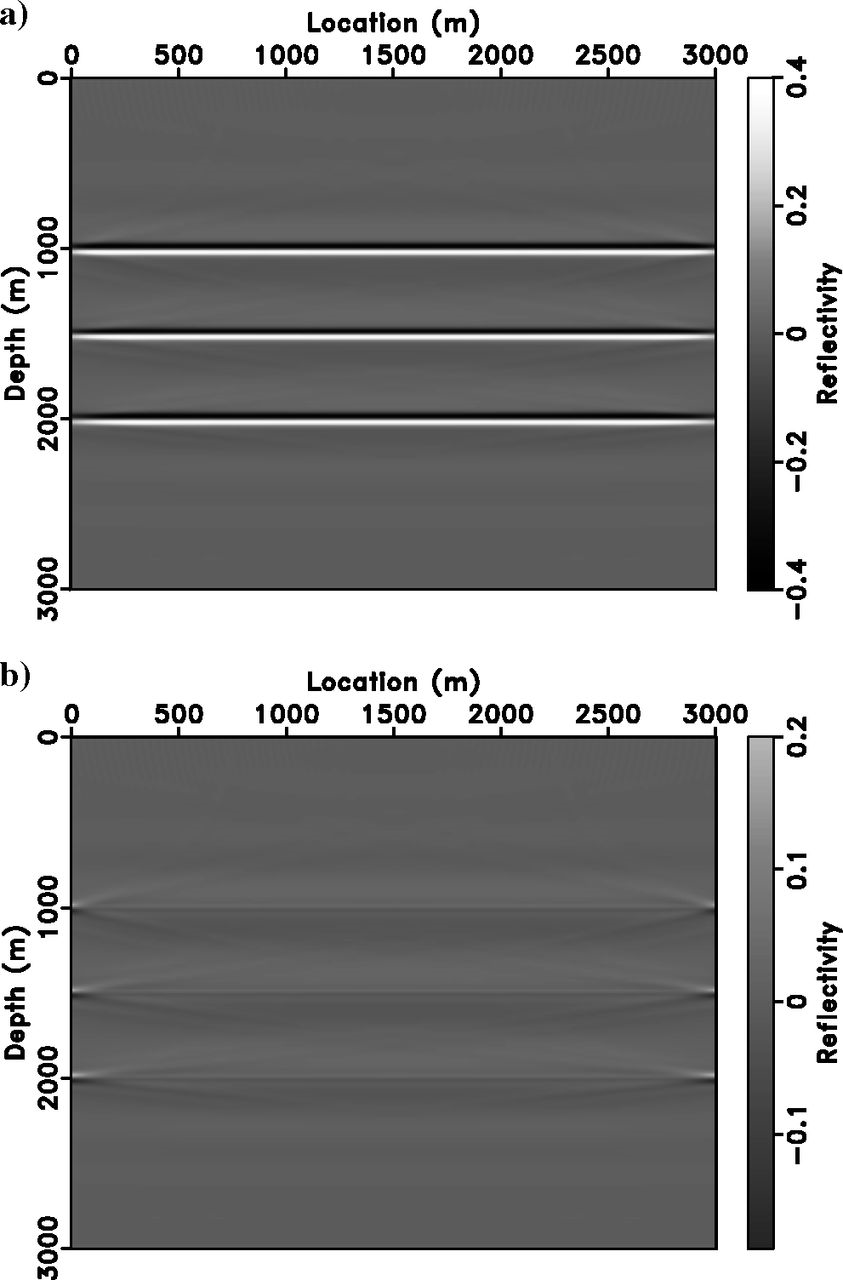
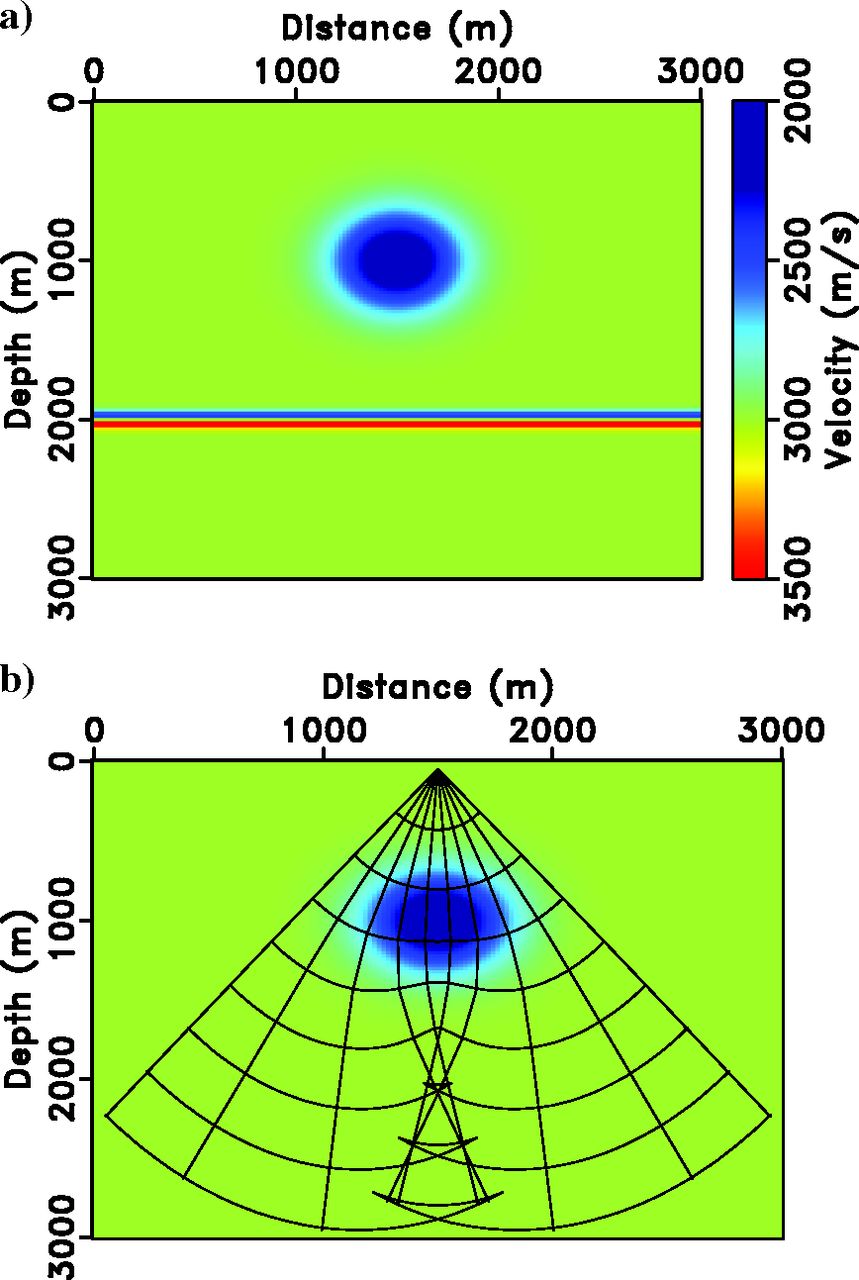
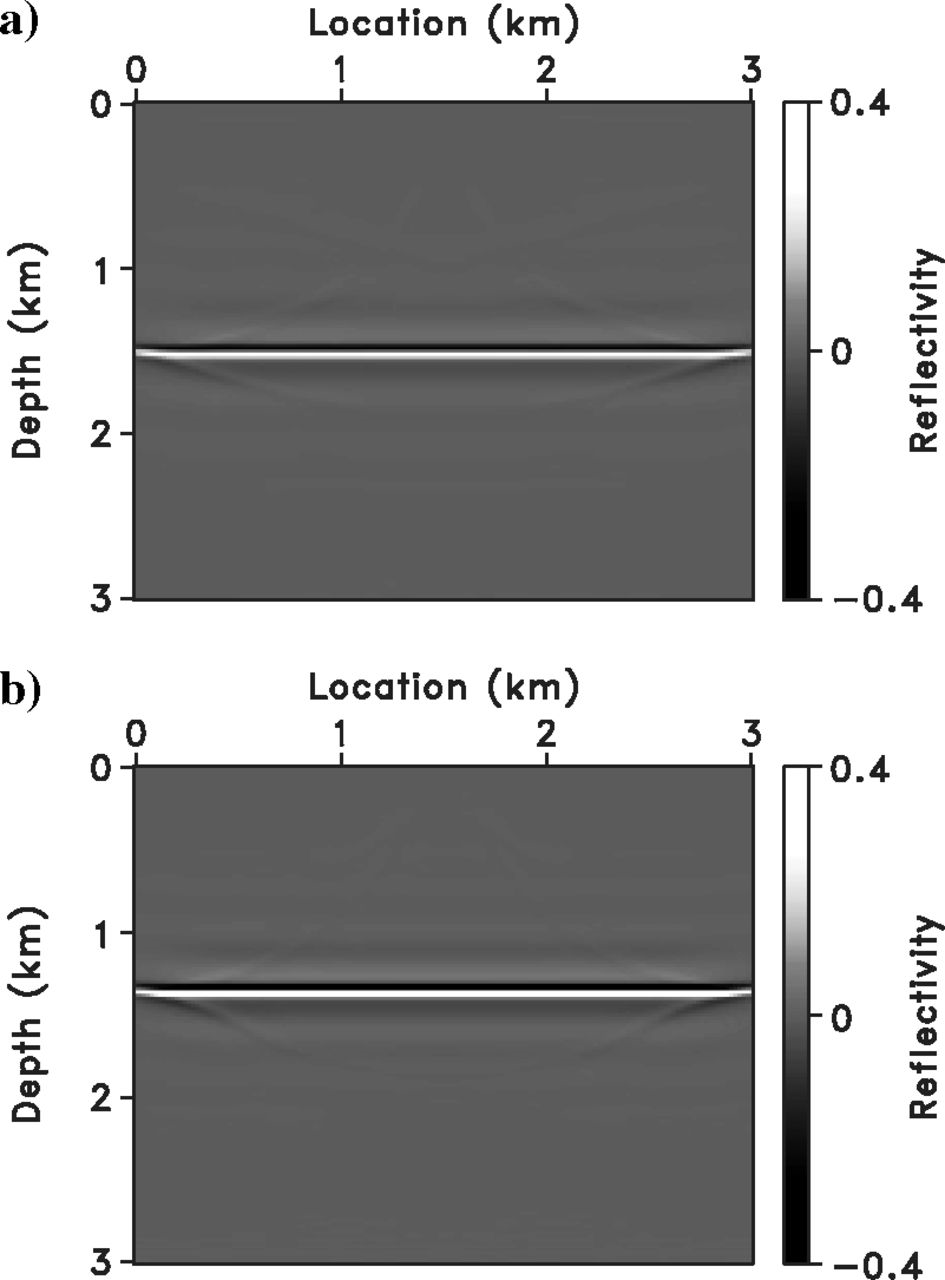
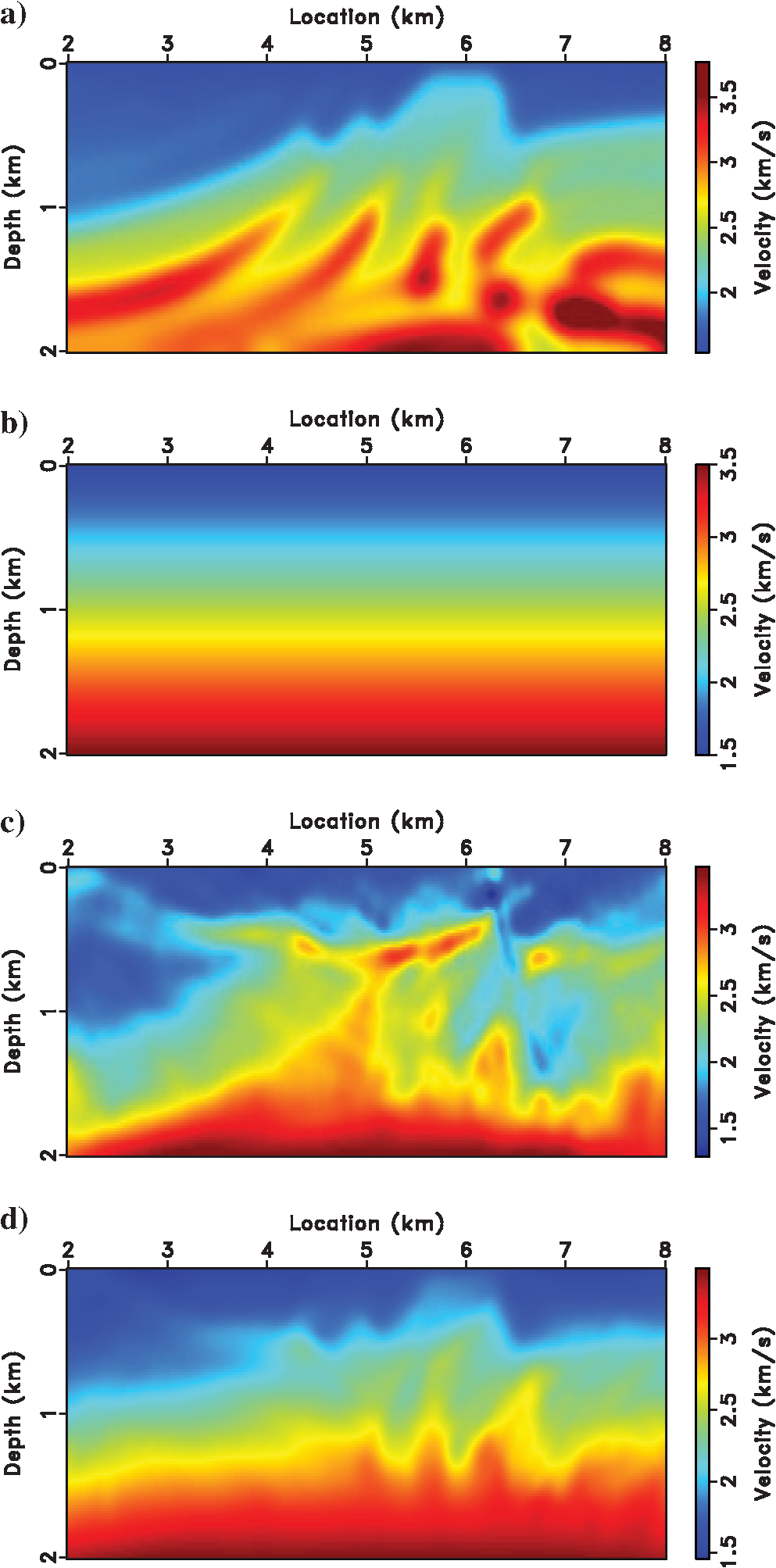
With incorrect velocity, the image is not focused at \(h = 0\) but the data is still fit. The offset range must be larger to accommodate the velocity error.

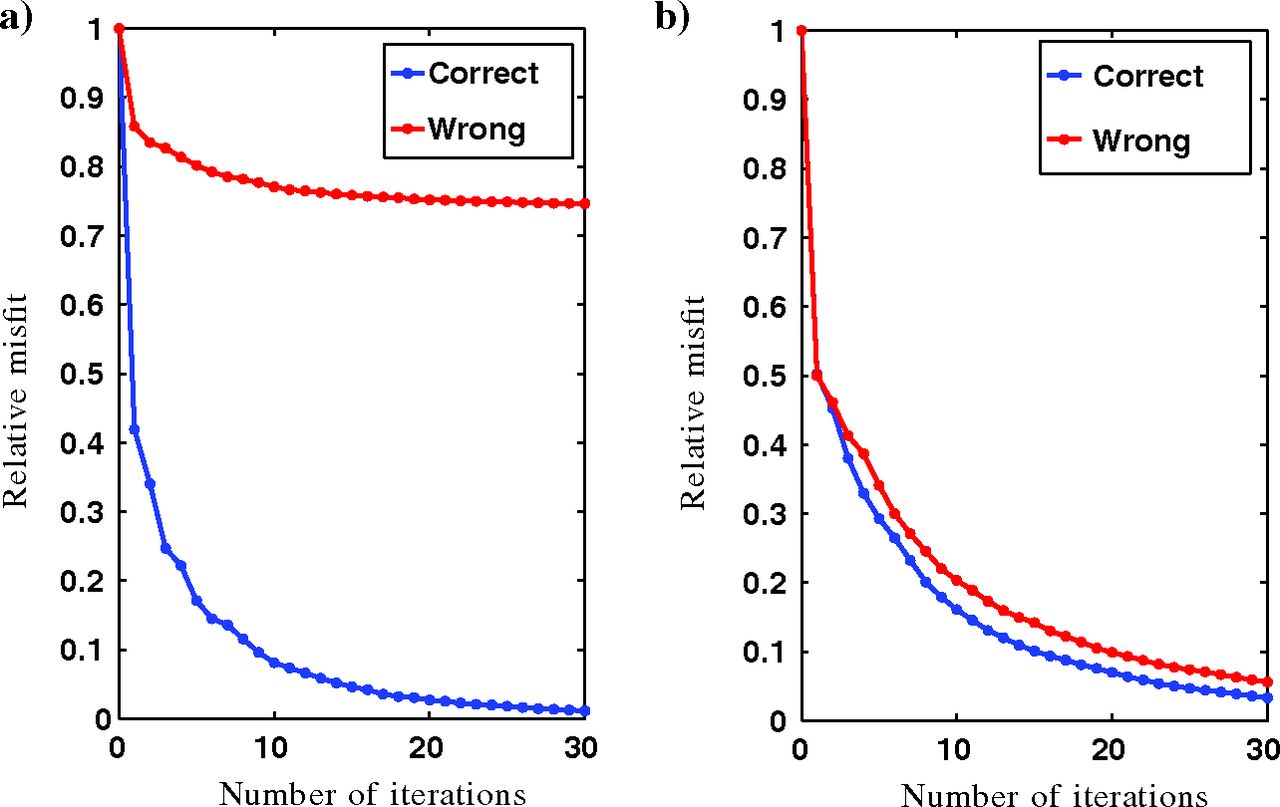
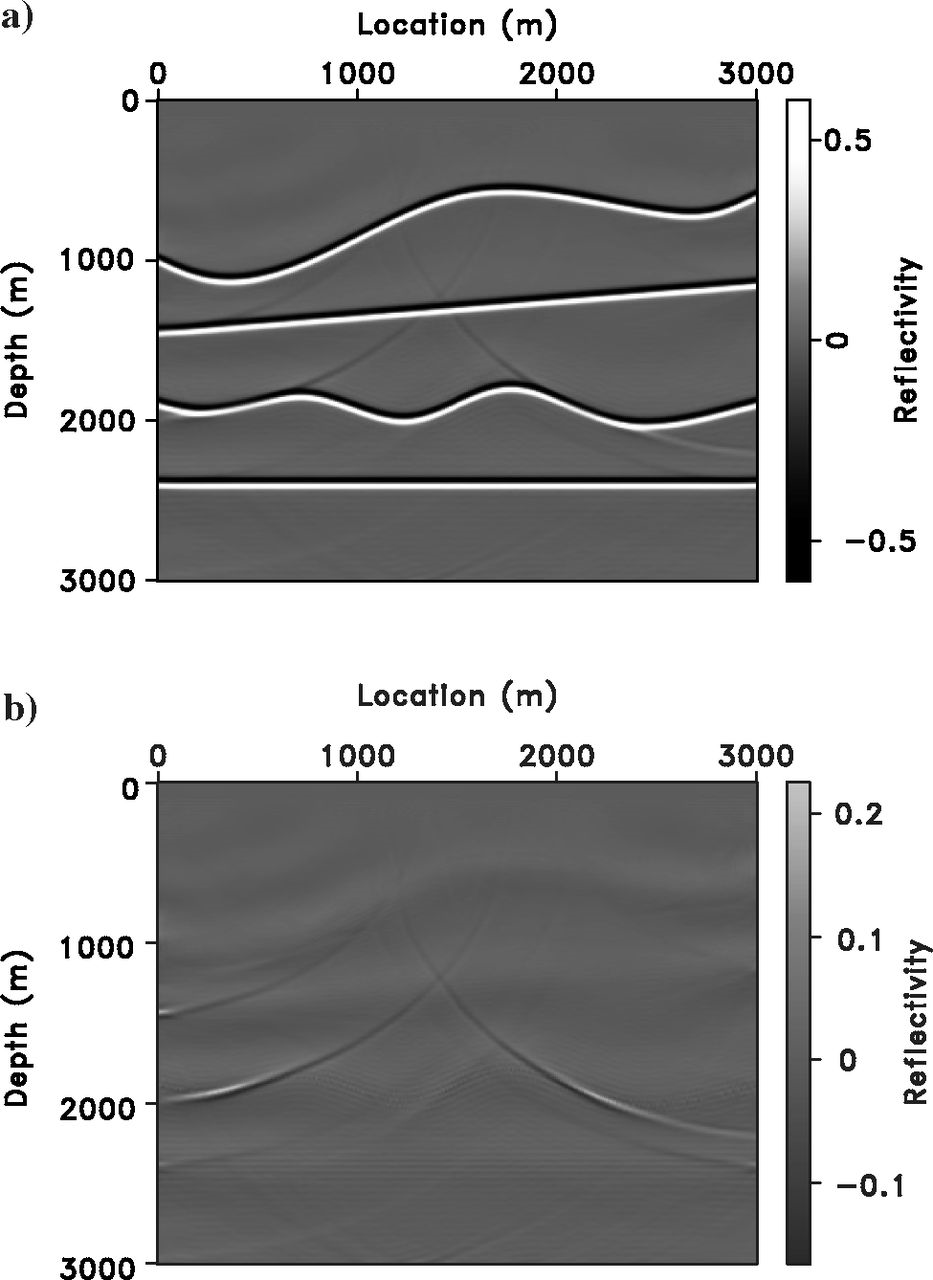
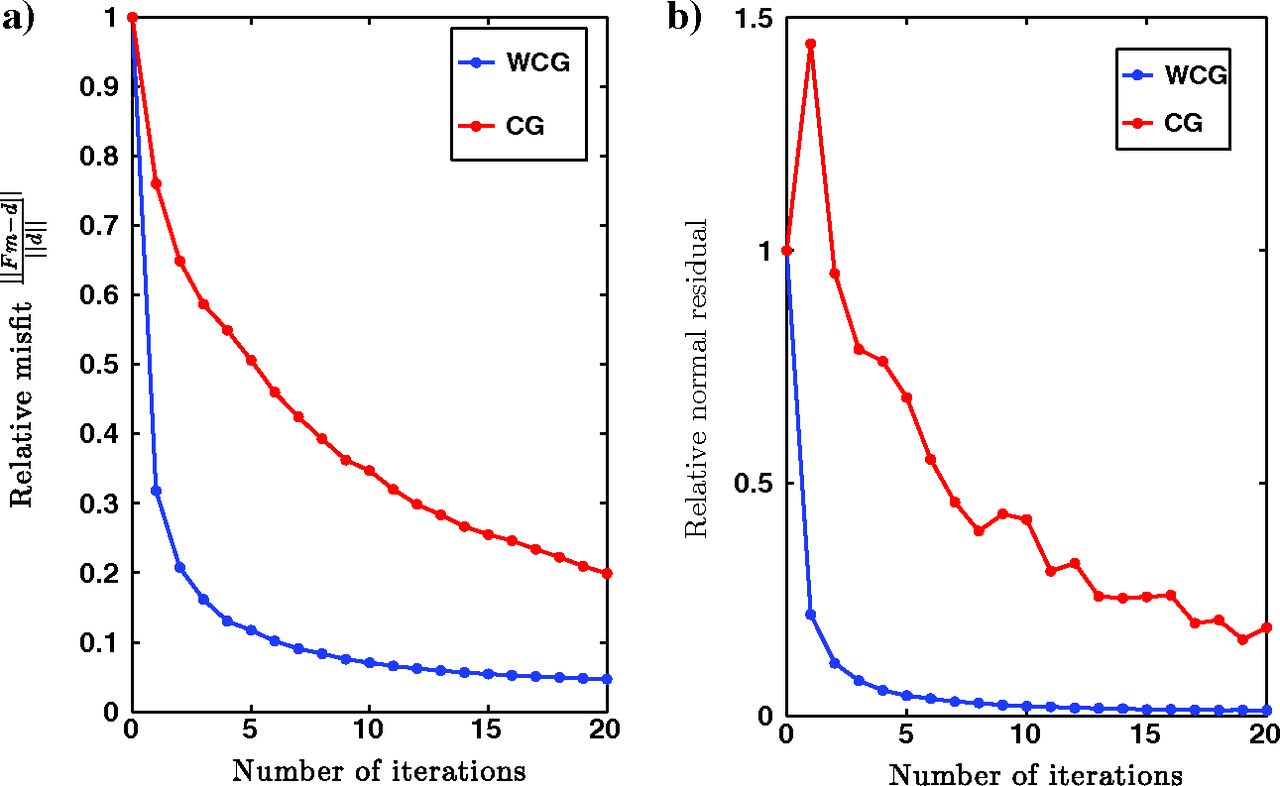
Because \(\bar{F}^\dagger \bar{F} \approx I\) (the extended Born operator is approximately unitary w.r.t. weighted norms), CG with weighted norms converges dramatically faster (Hou and Symes 2016).
The weighted CG uses inner products:
\[ \langle \delta\bar{v}_1, \delta\bar{v}_2 \rangle_{\text{model}} = \sum_{x,z,h} \delta\bar{v}_1(x,z,h)\,(W_{\text{model}}\,\delta\bar{v}_2)(x,z,h) \]
\[ \langle d_1, d_2 \rangle_{\text{data}} = \sum_{s,r,t} d_1(\mathbf{x}_s, \mathbf{x}_r, t)\,(W_{\text{data}}\, d_2)(\mathbf{x}_s, \mathbf{x}_r, t) \]
Algorithm 1 from Hou and Symes (2016). Inputs: operators \(\bar{F}\), \(\bar{F}^\dagger\), data \(\delta d\), initial estimate \(\delta\bar{v}_0\).
Note
Each iteration costs roughly the same as standard CG — one demigration (\(\bar{F}\)) and one migration (\(\bar{F}^\dagger\)). The weights add negligible cost.


Tip
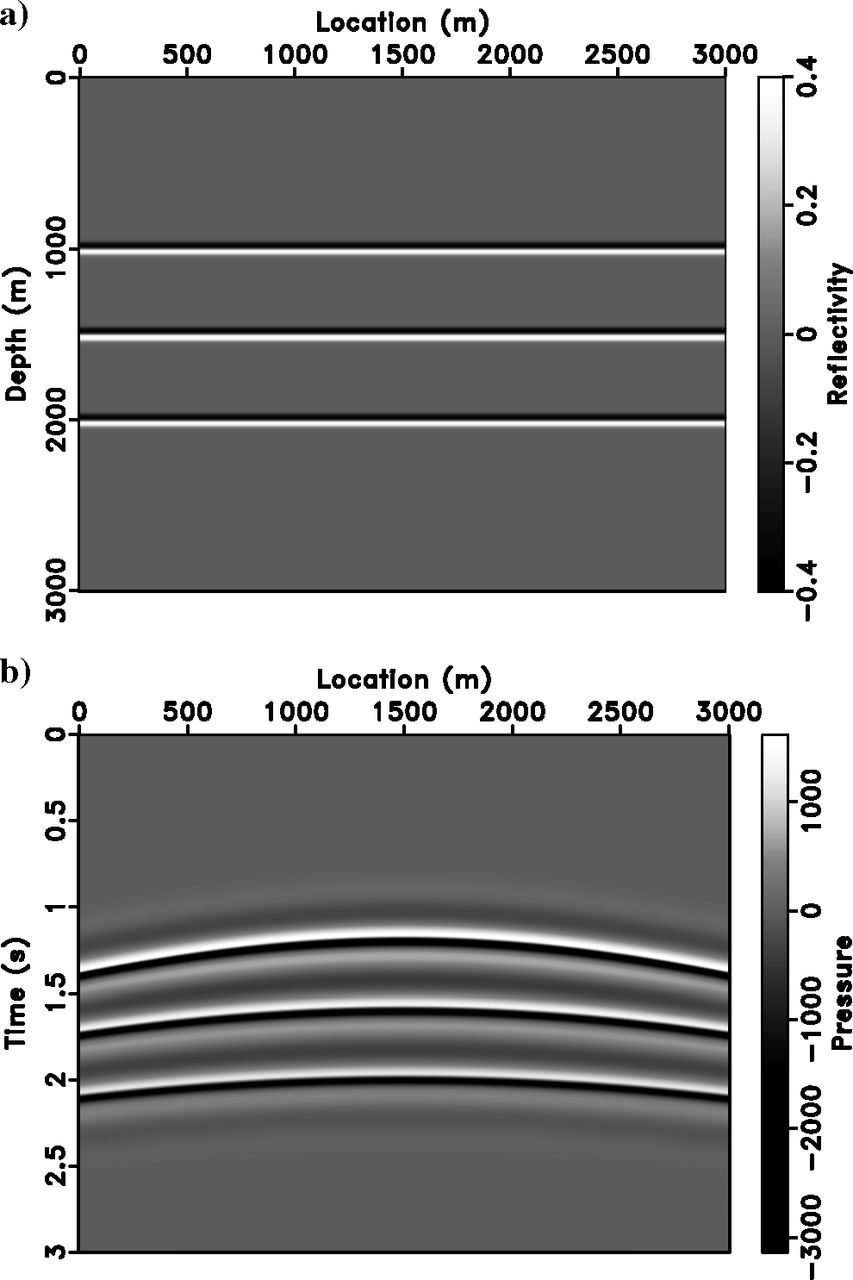
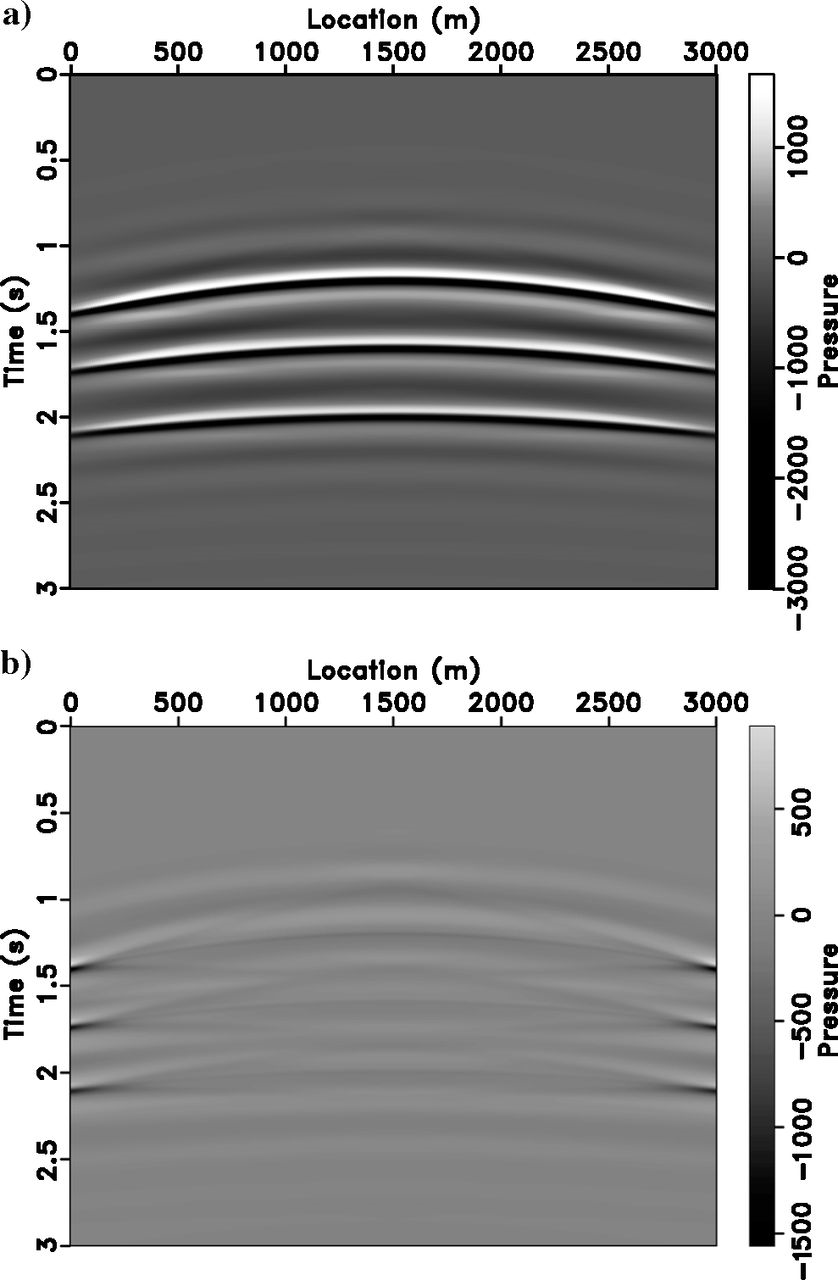
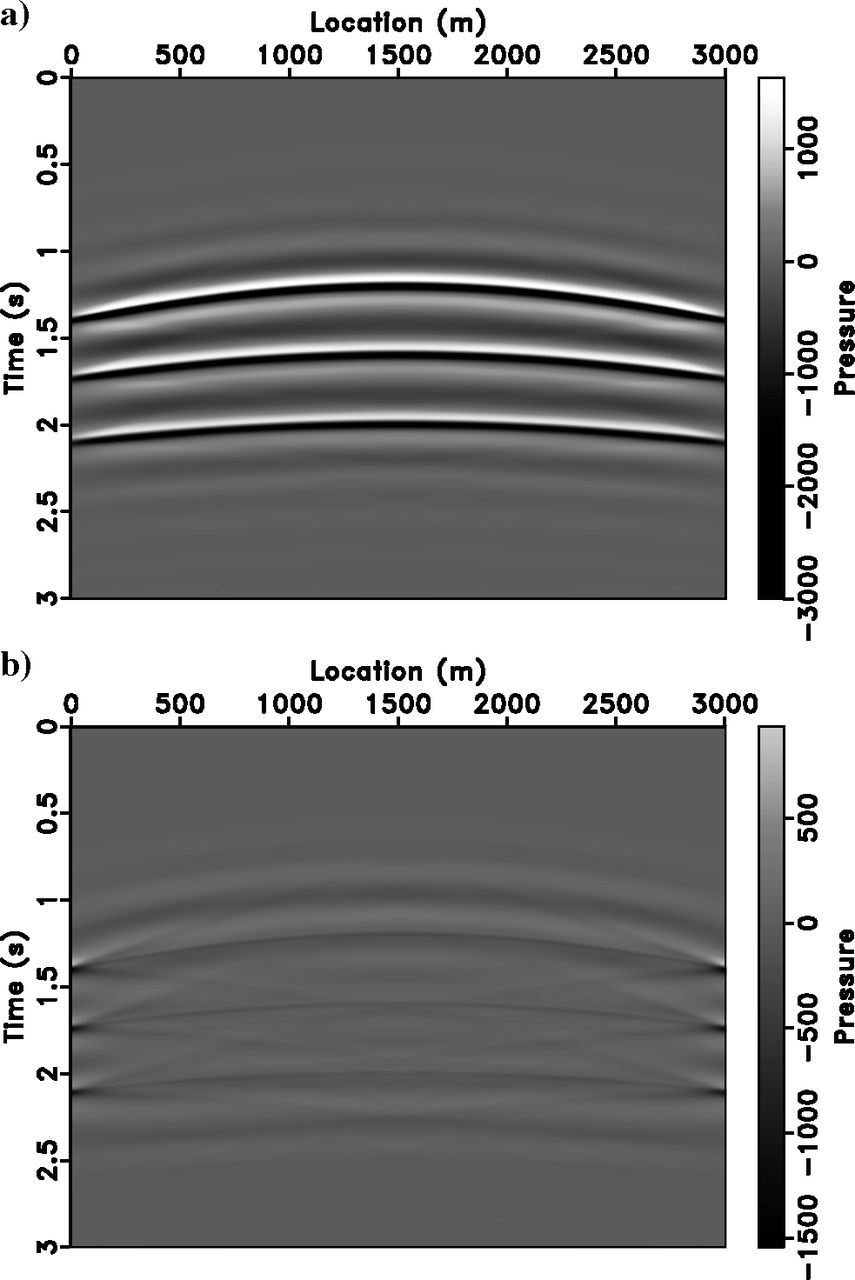
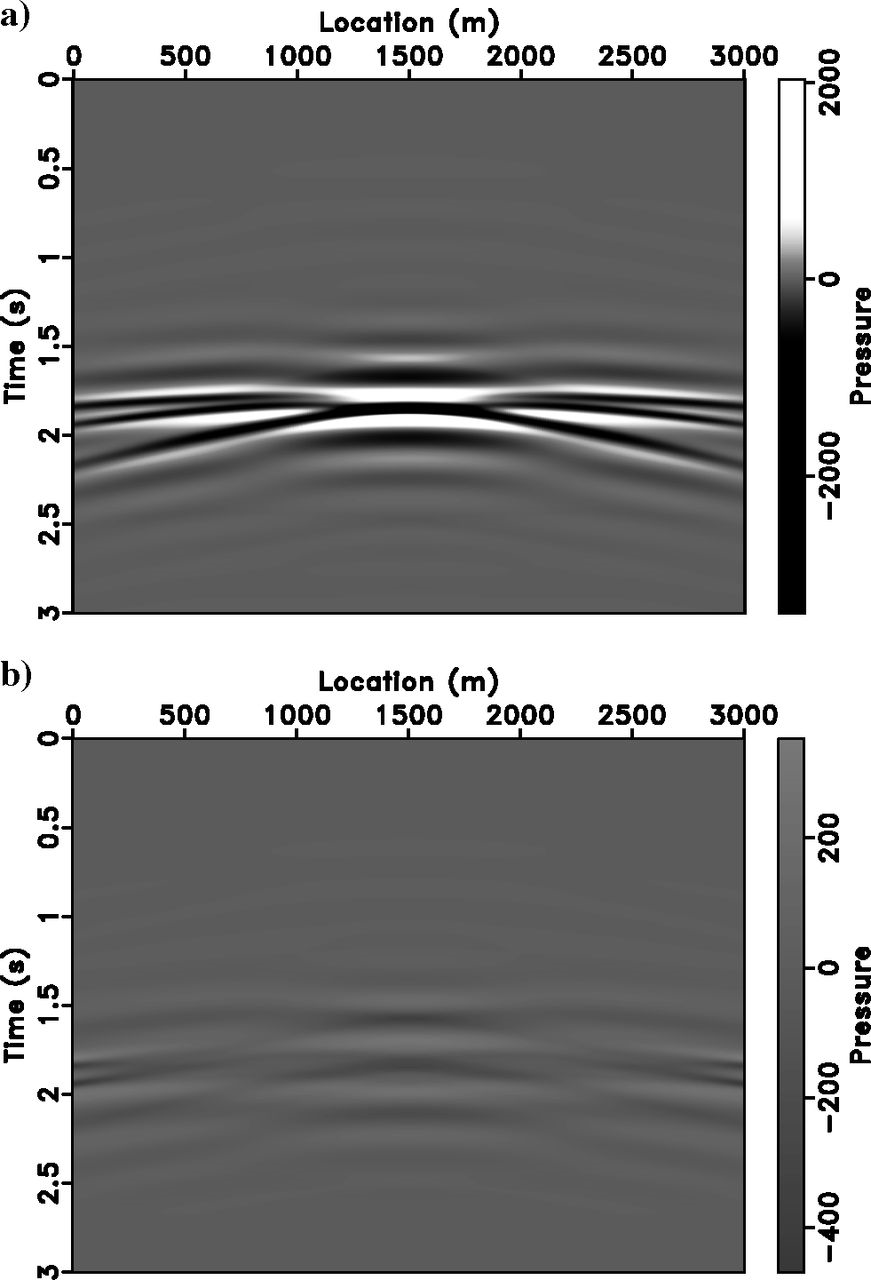
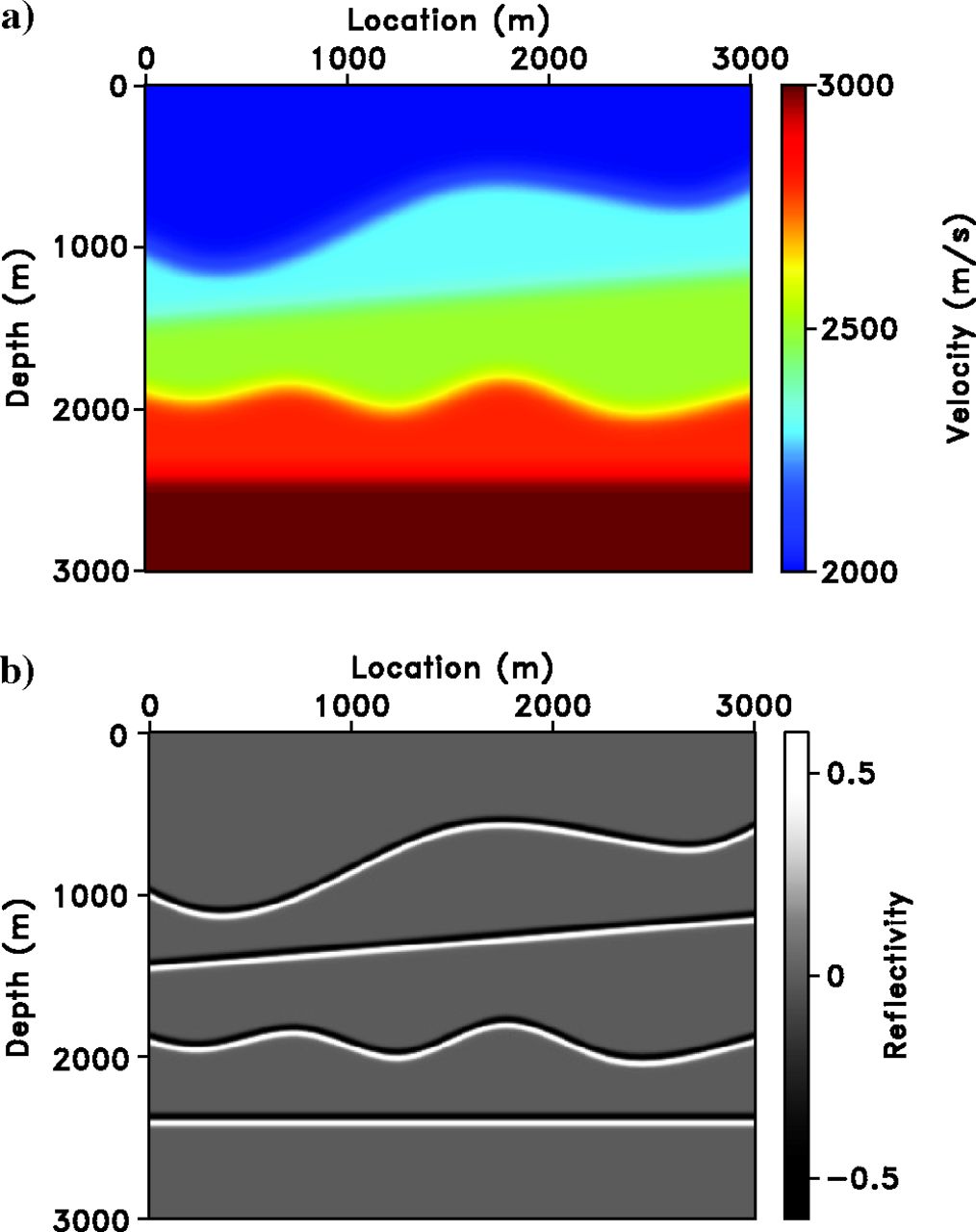
The residual is amplified by a factor of 10 — the actual misfit is very small, confirming accurate data fit.

Important
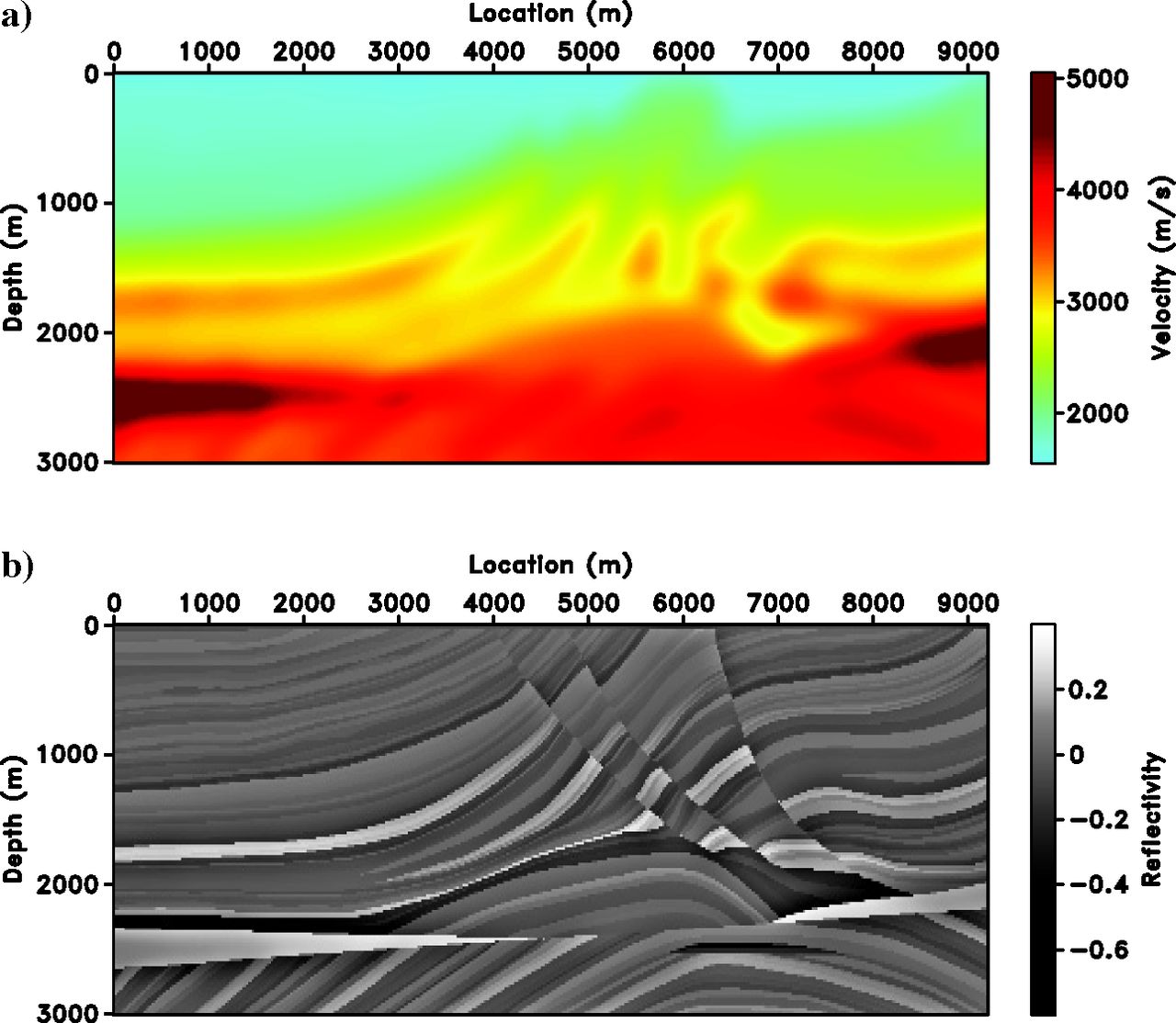
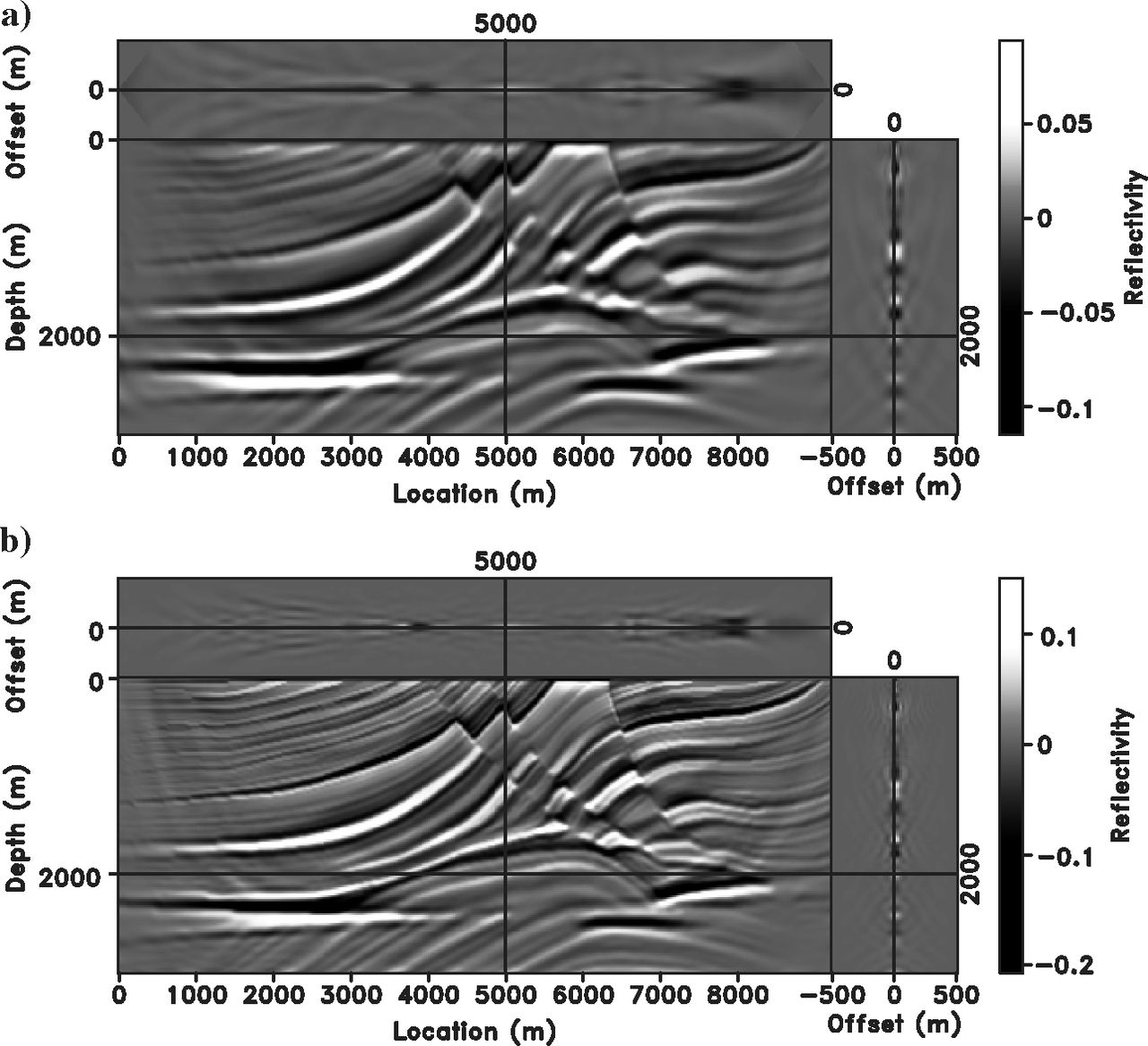
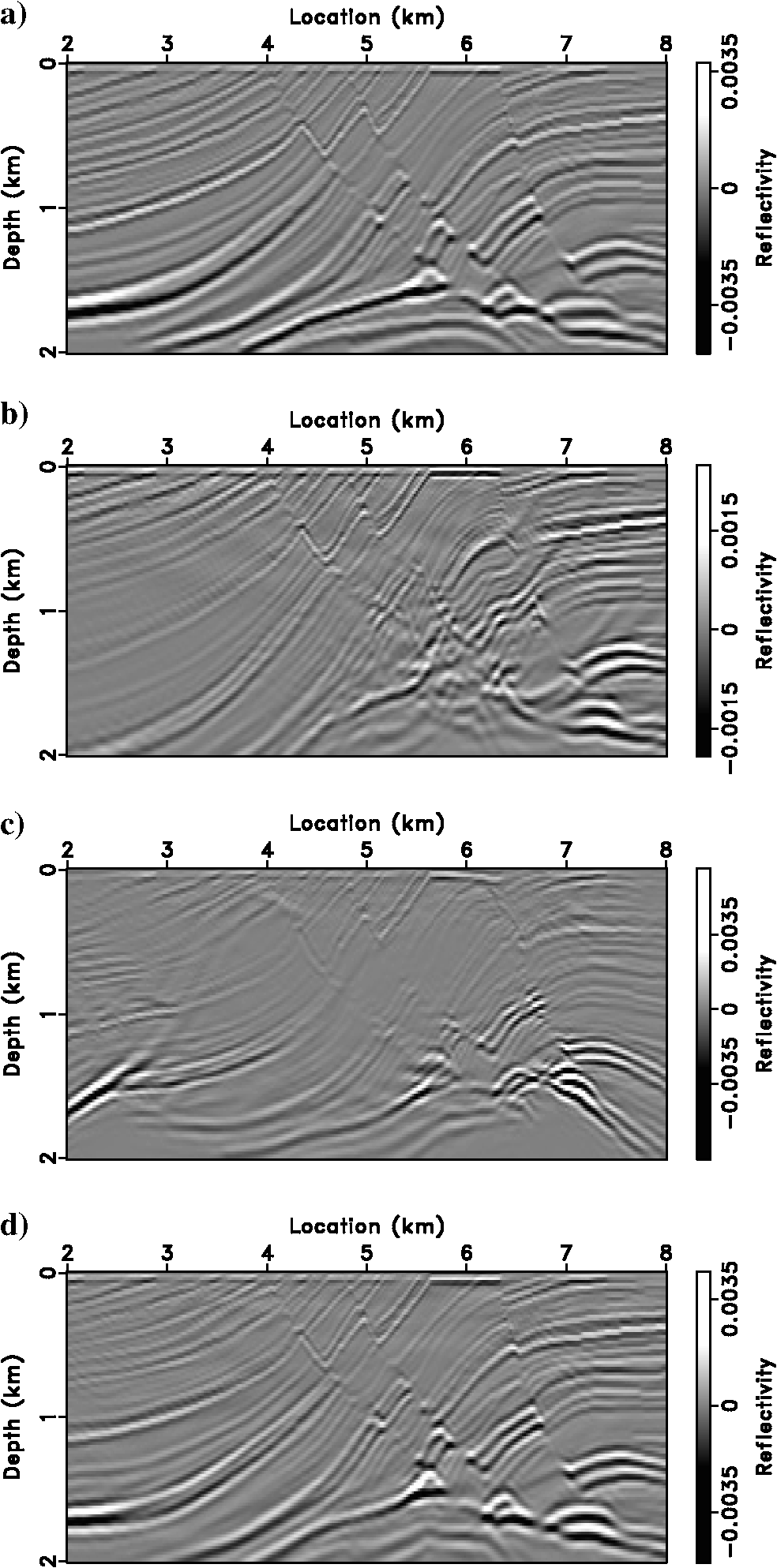
The image is not focused for the poor background velocity, yet data is fit (as in Figure 14). The offset range must be doubled (\([-1000, 1000]\) m) to accommodate the velocity error. This is the key feature exploited for velocity analysis.

Note
The convergence behavior with wrong velocity is very similar to the correct velocity case — WCG acceleration is robust to velocity error.
In the subsurface-offset domain, the semblance condition requires a focused offset gather. The DSO objective penalizes energy at nonzero offset (Hou and Symes 2018, Eq. 11):
\[ J[v] = \frac{1}{2}\|h\, I(\mathbf{x}, h)\|^2 \tag{5}\]
where \(I(\mathbf{x}, h)\) is the extended image from either RTM (\(\bar{F}^*\)) or the approximate inverse (\(\bar{F}^\dagger\)).

Critical observation
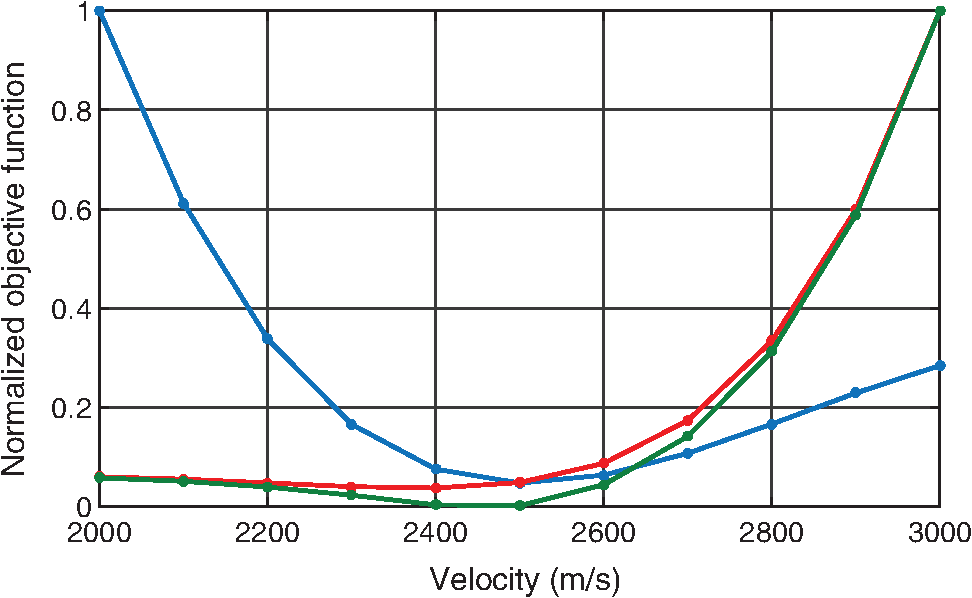
The MVA objective (red) has its minimum shifted to 2400 m/s — the wrong velocity! The IVA objective (blue) correctly minimizes at 2500 m/s. The so-called “gradient artifacts” are actually a problem of the objective function, not the gradient.


When RTM (the adjoint) is used instead of inversion, artifacts corrupt the velocity update (Hou and Symes 2018):
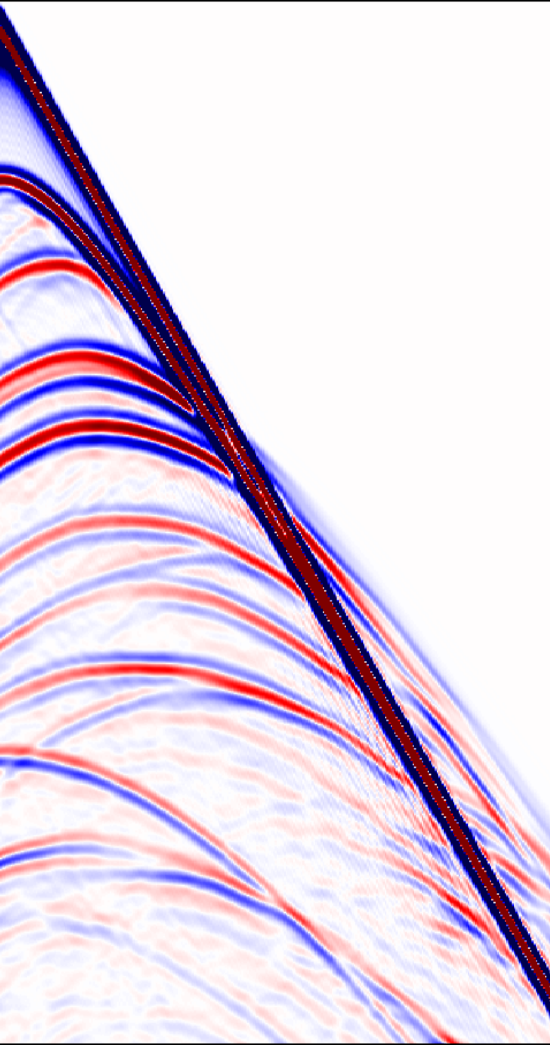
Despite the improvements from using the approximate inverse, WEMVA has fundamental issues:
Strong reflectors dominate the objective — The DSO objective \(J = \frac{1}{2}\|h\,I(\mathbf{x},h)\|^2\) is weighted toward high-amplitude events, which may not carry the best velocity information
Fails with strong multiples — Surface-related or internal multiples violate the single-scattering (Born) assumption, corrupting the image gathers and biasing the velocity update
Requires extensive hand-holding — Dip filtering, offset range selection, regularization, and balancing of DSO vs. stack-power terms all require manual tuning
Limited physics — The constant-density acoustic approximation and idealized 2D acquisition geometry are restrictive
The road ahead
These limitations motivate the transition to full-waveform inversion (FWI), which directly fits the data without requiring image-domain proxies. FWI will be the subject of our next lectures.
From image volumes to FWI
The main goal of subsurface-offset image volumes is to obtain estimates for the background velocity model \(v_0\). While WEMVA with the approximate inverse improves upon classical MVA, its fundamental limitations (dominance of strong reflectors, sensitivity to multiples, need for hand-holding) motivate the move to full-waveform inversion, which we cover next.
We leave the directional scattering aspect (AVA/AVP from image gathers) for a later lecture.